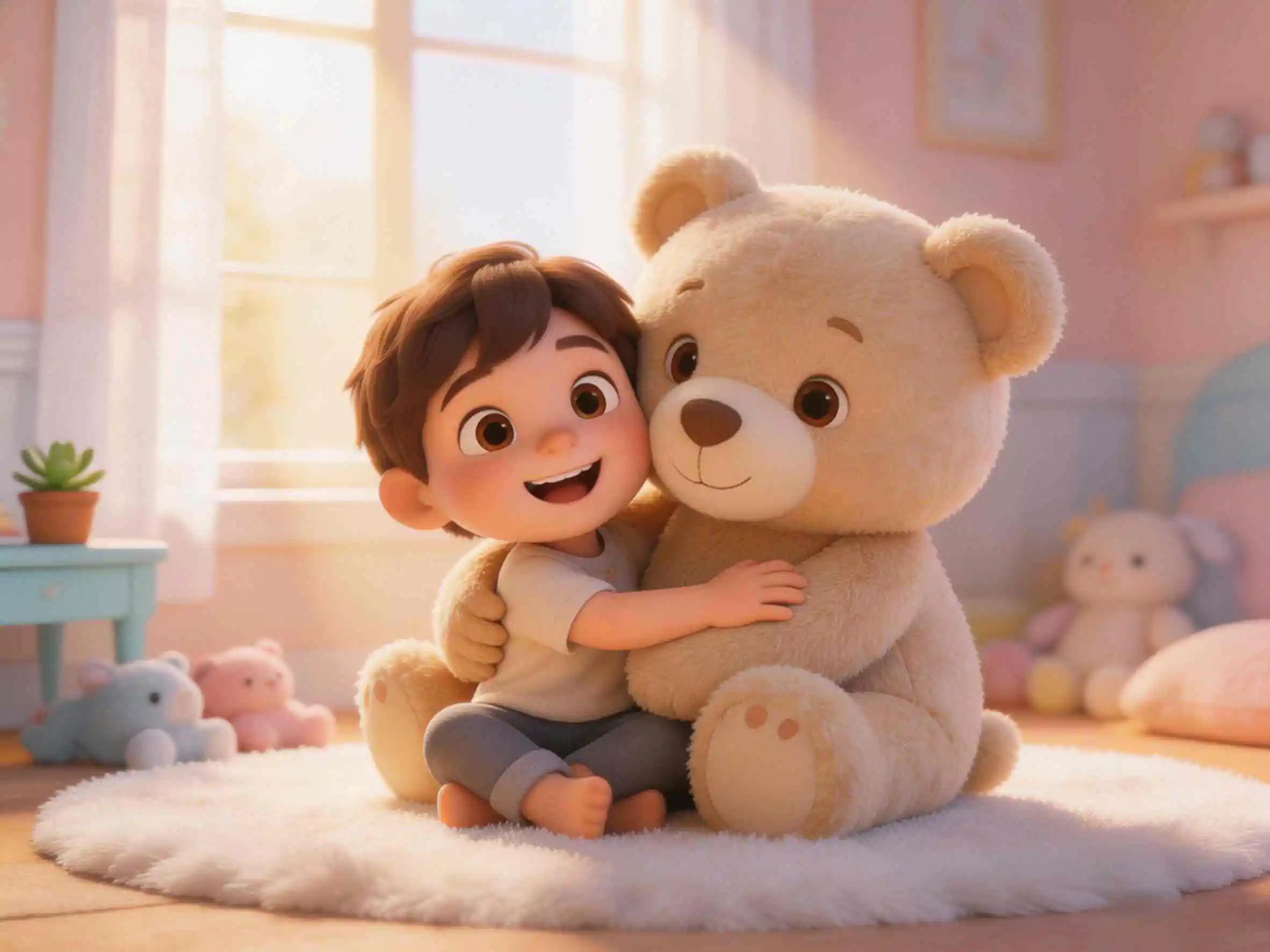
Teaching a five-year-old to wait at the curb is harder than teaching them fifty sight words — because road safety for kids is not vocabulary, it is behavior. A well-graded road safety story closes that gap: it wraps stop, look, listen inside a situation every child recognizes, and lets a brave character model the habit before the child ever stands at a real crossing. Our latest story, Luna's First Rescue: Stop, Look, Listen!, shows the result — a little knight saves an impatient fox named Ruby, teaches her the three magic words of the street, and the whole scene ships as a finished kids' video instead of a lesson-plan to-do list.
KiVi AI turns a graded moral-story script straight into synchronized, multi-speaker animation — no voice actors, no manual keyframing, no extra audio editing. From road-safety tales to honesty and friendship stories, one workspace covers the full pipeline: script the moral story, sync natural voiceovers, keep characters consistent across episodes, and publish fast enough to grow a kids' channel.
Learning About Road Safety Through Stories: Why It Works
For young children, learning about road safety through a story beats memorizing a poster of rules. The gap between reciting "red means stop" and actually stopping at a curb is an emotional gap, and a well-structured road safety story for kids closes it by placing the rule inside a moment of real (but safe) danger — a near miss, a scolding avoided, a hero who helps instead of lectures. Pair expressive cartoon visuals with clear, evenly paced dialogue and children absorb the rule as a habit instead of a slogan to forget.
- A relatable scene: Ruby the Fox skips out of school in a hurry to watch her cartoon, sees a busy street, and dashes out — a moment of impatience every child (and every parent watching) instantly recognizes.
- Rules delivered as a chant, not a lecture: Luna teaches the three magic words — "Stop! Look! Listen!" — repeated three times with matching actions: freeze at the edge, look left-right-left, cover one ear and listen for cars.
- Natural cause and effect: The consequence appears inside the story rather than in a warning: "That car was very, very close." Then the payoff: crossing safely still gets Ruby home in time for her show.
- Core vocabulary reinforcement: stop, look, listen, safe, crosswalk, traffic light, hurry are anchored to visible character actions, so the words stick through dual coding — sound plus image — and the hero passes the lesson on when Ruby teaches little Wolfie the same chant.
Episode 1 of the Luna the Little Knight series — new episodes and articles every week. Subscribe to follow along.
Create a Moral Story AnimationWhat the AI Dialogue Generator Solves: Four Pain Points
Producing a clear, well-paced story between animated characters has historically meant coordinating voice talent and spending hours on manual lip-syncing — costs that push most solo creators and small kids' studios out of animated content entirely. With KiVi AI's dialogue generator, any graded moral-story script becomes a finished animated episode in minutes. Here is what actually changes:
- Pain point 1 — voice production cost: A separate, clear voice is generated per character — a warm narrator, a gentle Luna, an excited Ruby — with automatic phoneme-accurate lip sync, so children see correct pronunciation cues without any post-production alignment work.
- Pain point 2 — pacing that ignores young viewers: You paste your moral-story script directly, or refine the rhythm turn by turn, preserving the pauses children need to echo the safety chant out loud.
- Pain point 3 — character drift across scenes: Character IP Lock keeps Luna's red cape, Hazel's acorn badge and Ruby's outfit identical as they move from the school gate to the curb to the crosswalk — the consistency problem that traditionally required frame-by-frame redraws, and the key to a recognizable series.
- Pain point 4 — one style for every audience: Render safety stories as vibrant 2D preschool cartoons or expressive 3D animation (browse the animation styles gallery), so the same script can serve toddlers, ESL classrooms and family viewers.
Safety Rules for Kids: How to Write the Story Script (Template)
Turning safety rules for kids into a story only works if the lines are right. Before generating anything, lock in one safety behavior per scene and keep every turn under about 12 words — short enough for a readable subtitle and for a child to echo out loud. This is the pattern Luna's First Rescue follows:
| Story beat | Line to lock in | Where it lands in the scene |
|---|---|---|
| The near miss (cause and effect) | "RUBY, STOP!" — "Oh no... that car was very close." | The busy street, Ruby mid-dash |
| The rule as a chant | "Three magic words: Stop! Look! Listen!" | Curbside, Luna holding up three fingers |
| Practicing the rule | "Look left. Look right. Look left again." | At the zebra crosswalk |
| Checking safety before crossing | "I hear no cars! It's safe. Let's cross together." | Listening with one ear covered |
| Passing the lesson on (the moral lands) | "One hero can make another hero!" | Closing shot, Ruby teaching Wolfie |
Two production rules follow from the script: give each character a clearly different voice so young viewers can tell speakers apart with their eyes closed, and repeat the safety chant at least three times per episode. Both are cheap to enforce at script stage and expensive to fix after animation.
How to Make a Moral Story Video in KiVi AI
Turning that safety script into a publish-ready kids'AI 3D cartoon takes four steps, all inside the same workspace:
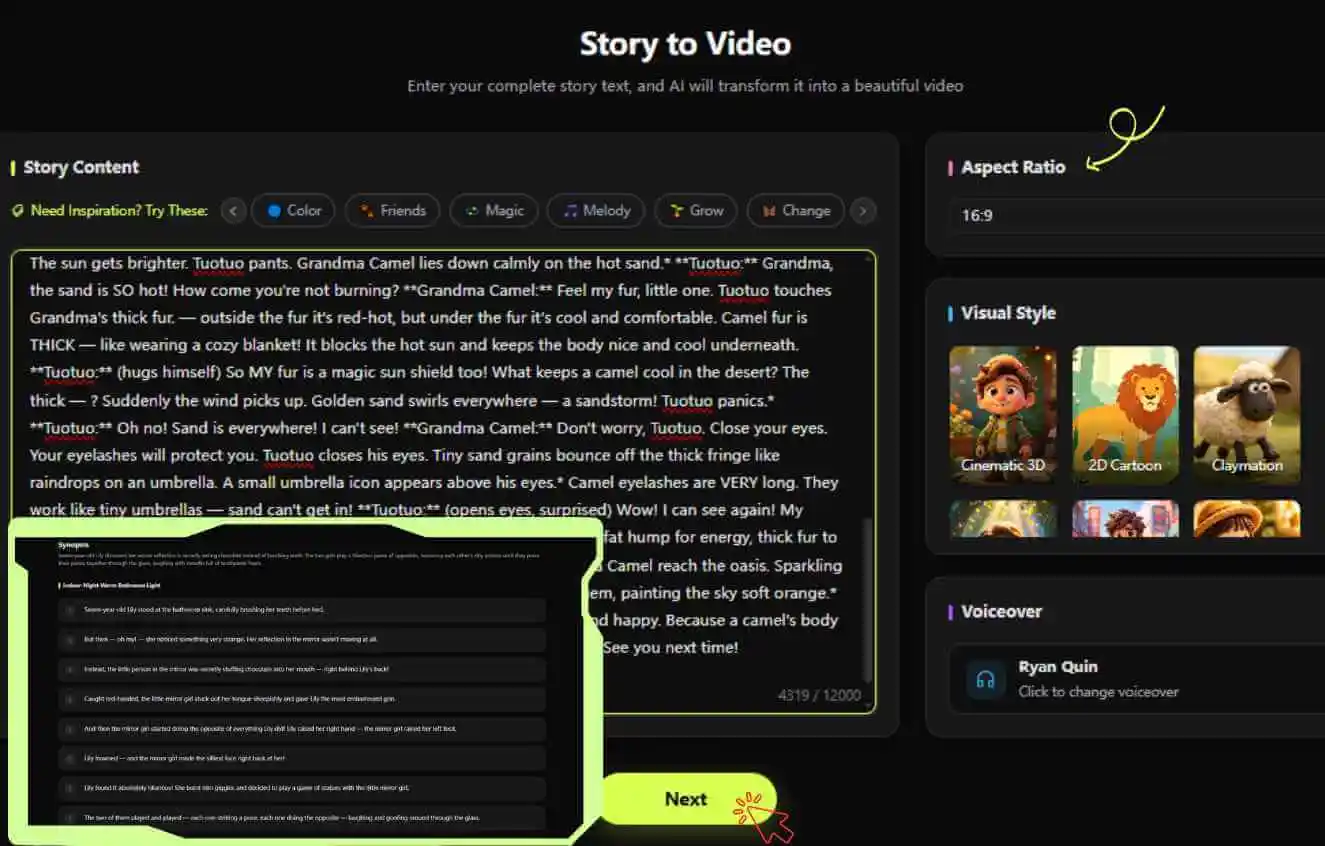
Step 1: Create Your Story
Start with your moral story — for example, "A little knight teaches an impatient fox to stop, look and listen at a busy street." Choose Narration or Character Dialogue, then set the video parameters: aspect ratio, language and visual style.
Step 2: Develop the Story & Dialogue Script
Let AI draft the story outline in Narration mode, or produce an editable script in Character Dialogue mode. Rewrite the lines here — vocabulary level, chant repetition, pause points — before anything is rendered.
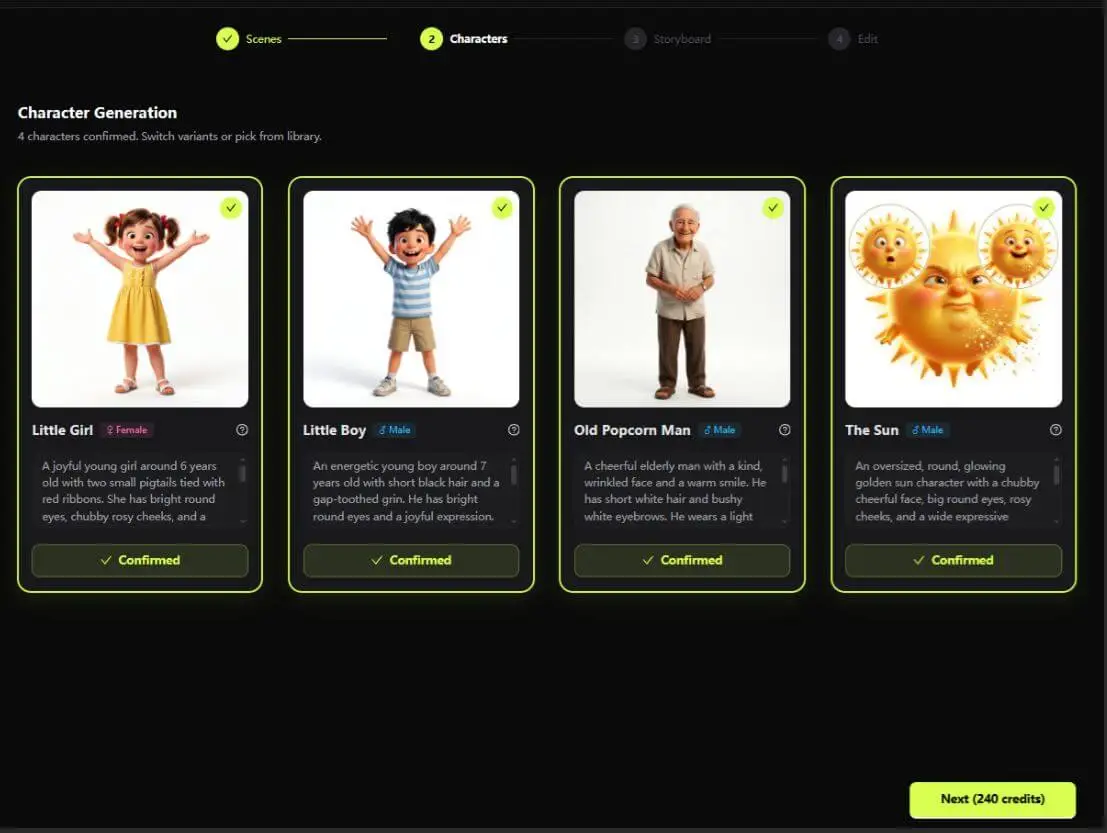
Step 3: Design Characters & Build Storyboards
Pick the AI-generated designs for Luna, Ruby and Hazel, assign a distinct voice to each, and turn the script into storyboards. Adjust scene prompts and lines while the character models stay locked — the red cape stays red in every episode.
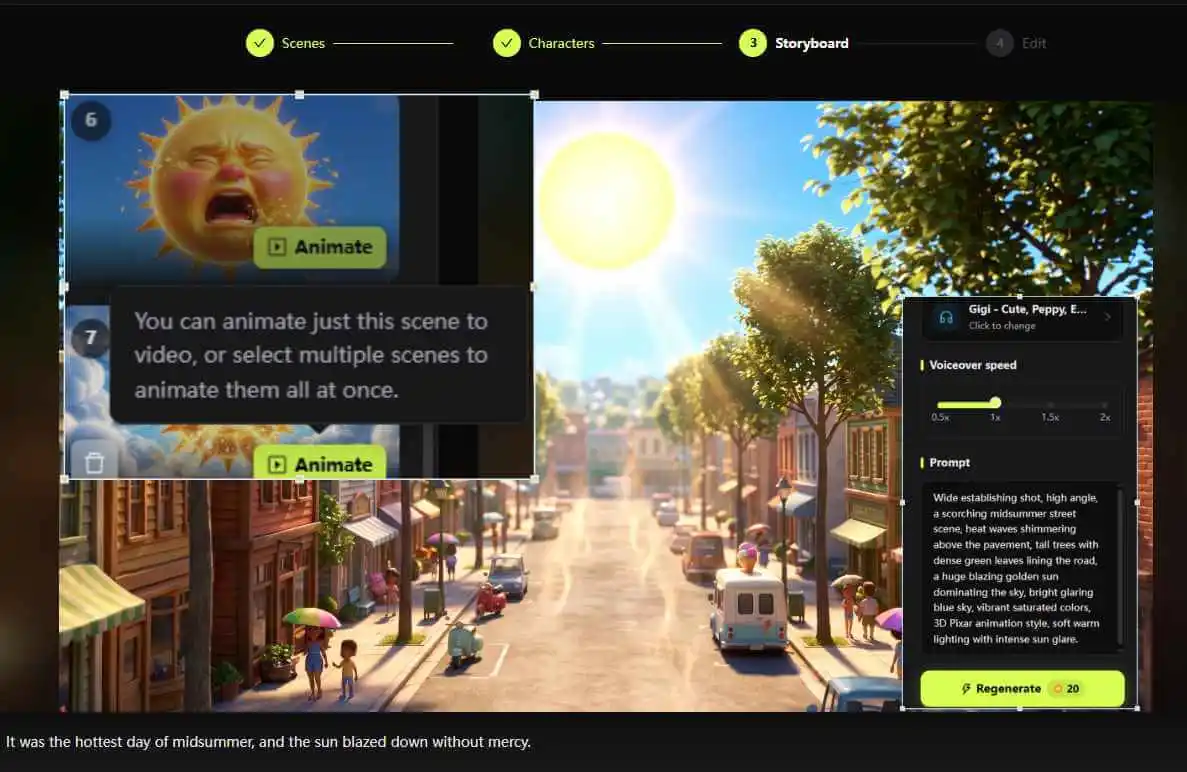
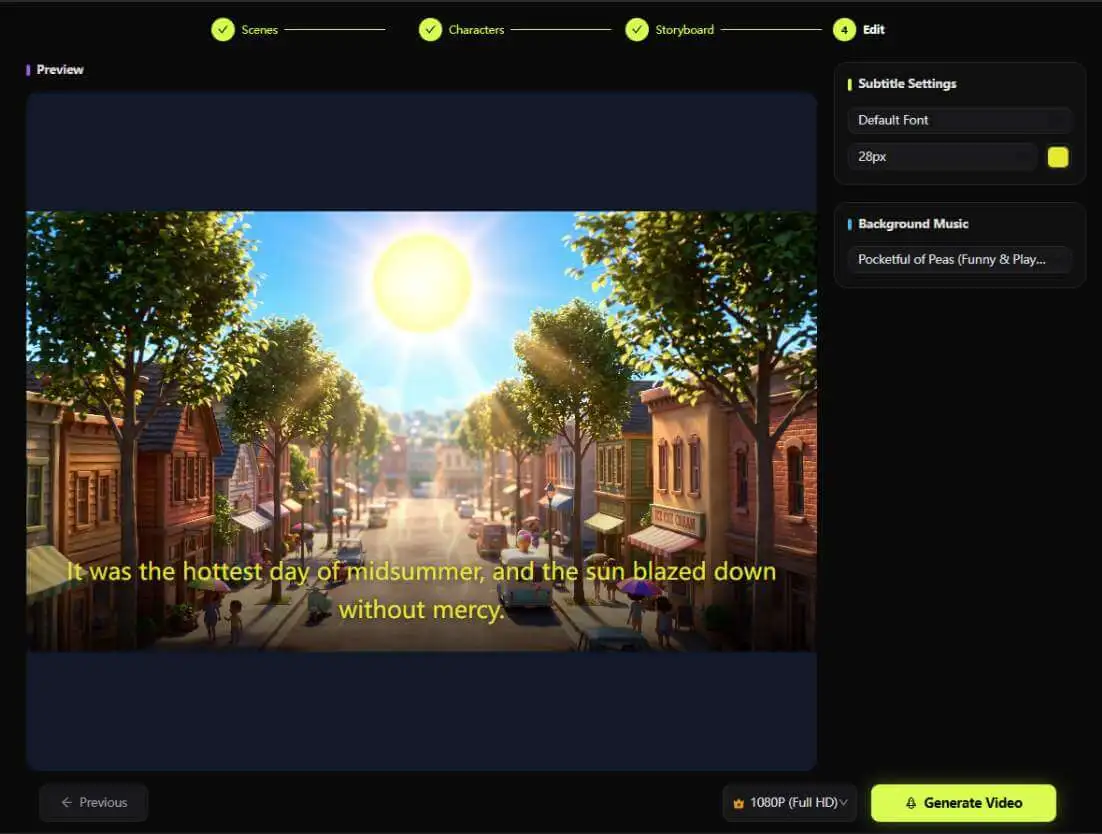
Step 4: Animate, Caption & Export
Animate the shots you keep, add subtitles and gentle background music, review the lip sync on the safety chant, then export in 16:9 for the full episode or 9:16 for a 30-second "Knight's Lesson" Short.
AI Dialogue Generator vs. Traditional Kids' Animation Production
A traditional animated safety episode coordinates voice talent, illustrators and video editors — and every script revision restarts part of that chain. A story-to-video workflow collapses it into a single editing surface:
| Production category | Traditional kids' animation workflow | KiVi AI dialogue generator |
|---|---|---|
| Voiceover & pronunciation | Hire several voice actors, then align mouth shapes to the audio tracks by hand. | Generates a clear voice per character with automatic phoneme-accurate lip sync. |
| Character continuity | Redrawing Luna's cape and Ruby's outfit against new street backgrounds is slow and costly. | Character IP Lock holds Luna's exact appearance across every scene cut and every episode. |
| Script-level changes | Adjusting the chant wording or simplifying a sentence means re-recording audio and re-cutting scenes. | Edit any sentence in the browser and regenerate that scene within seconds. |
| Publishing frequency | A single five-minute animated safety story takes weeks to finish. | Multiple moral-story episodes can ship every week from the same series template. |
Building a Moral Story YouTube Channel for Kids
Children follow recurring characters through familiar situations — which is exactly why a knight-and-friends series outperforms one-off safety videos on retention. Pairing a structured moral-story script library with an automated character dialogue animation pipeline makes a sustainable kids' channel realistic for a one- or two-person team:
- Build a themed episode series: Follow Luna from Luna's First Rescue through The Stranger's Candy, Earthquake Drill Day and No Swimming Alone — one safety behavior per episode, one chant per rule.
- Design for echo practice: Keep the "Stop! Look! Listen!" chant clean and evenly paced so young viewers can pause and repeat it out loud — the highest-impact safety habit at this age.
- Keep visual branding consistent: Reuse the same character models, thumbnail layout and end-screen "Knight's Lesson" card so families recognize the series before they read the title — and so every new episode costs a fraction of the first.
The compounding effect is the point: episode 10 costs a fraction of episode 1, because the cast, the style and the story skeleton already exist.
Explore the Kids' Video GeneratorFrequently Asked Questions
Conclusion: Start With One Safety Story
Stories like Luna's First Rescue: Stop, Look, Listen! show what a well-designed road safety story for kids can do: a relatable near-miss, a chantable rule and a hero who passes the lesson on turn learning about road safety into something children ask to rewatch. What used to require a production team now takes an afternoon.
Whether you are growing a kids' YouTube channel, turning safety rules for kids into classroom materials, or developing a recurring moral-story series, KiVi AI keeps the work on storytelling instead of production overhead. Script your next safety episode, generate the character dialogue animation, and publish it this week.
Ready to animate your road safety story for kids?
Turn safety rules for kids into multi-character cartoon videos with KiVi AI's dialogue generator.